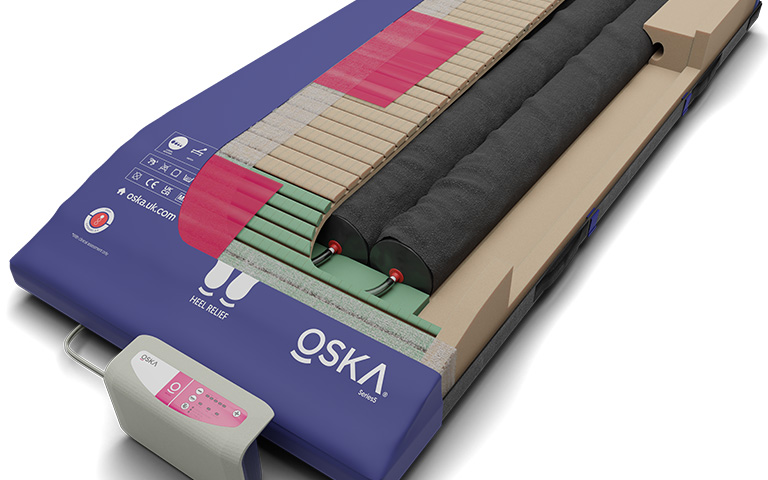
The OSKA Series5 lateral tilting mattress has been designed to deliver high levels of pressure redistribution, through immersion and envelopment, whilst also reducing shear forces and providing stability, safety, and comfort, whether it is in dynamic or lateral rotation mode. The Series5 is suitable as an aid in the prevention and treatment of pressure ulcers up to and including Category 4 and is indicated for patients with complex needs such as palliative, critically ill, or where repositioning is difficult to achieve.
The Series5 is contra-indicated for patients with:
- Unstable spinal fractures
- Unstable spinal cord injury
- Unstable skeletal fractures
- Skeletal traction
- Physician orders prohibiting rotation
- Severe burn, to the posterior aspect of the body, that requires skin grafts
With a lot of different lateral tilting products on the market it can sometimes be difficult to know which one is most suited to your patient’s clinical needs and will provide the best clinical outcomes based on those needs. To help you in your decision making, to follow are some of the key clinical benefits to using the Series5 lateral turning mattress.
Reduction of Shear Forces:
When shear and friction forces are applied to the superficial and deep body tissues, they can be stretched, and blood vessels torn and twisted, which in turn can cause tissue oedema, inflammation and impede blood flow.1 This, in conjunction with the forces of pressure, can compromise tissue integrity and result in some patients developing severe pressure damage. A large number of lateral tilting mattresses and devices lift the support surface the patient is lying on, up and laterally, to create a 30° tilt.
Tilting a patient’s support surface laterally will result in the torso being shifted to one side which can increase shear and friction force to the tissue in the opposite direction.1 Therefore, the development of a lateral tilting mattress, such as the Series5, that sinks the patient gently into the surface, rather than lifting them up directly onto their side, will help to reduce these shear and friction forces. In addition, the Series5 has inbuilt anti-shear zones which help to further reduce shear forces over the most vulnerable bony prominences, the shoulders, sacrum and heels.
Patient Comfort:
Many tilting platforms and mattresses focus on lifting the patient support surface up, tilting them quite substantially on to either side. However, this movement can be perceived by the patient as quite aggressive, and result in increased patient anxiety and fear of tipping out of bed, especially patients suffering from confusion and disorientation.
Instead, the Series5 provides a gentle movement which gradually sinks the patient into the support surface producing a 20° tilt which is not only clinically effective at pressure redistribution,2 but also comfortable for the patient.3 Patient comfort and stability is further enhanced by the top foam layer which cradles the patient whilst the mattress is tilting, therefore providing support. The top foam layer provides additional patient benefits by providing high quality immersion and envelopment which has been shown to be essential in the reduction of pressure near the bony prominences.4
Risk of Falls & Entrapment:
Many tilting devices lift a patient, or their support surface, up to such a degree that manufacturers often specify the use of side rails to lower the risk of patients rolling out of bed during the process of lateral tilting. However, the use of siderails alongside a lateral tilting device could increase the risk of entrapment if the equipment is not correctly assessed and measured for.
The Series5 minimises the risk of falls, entrapment, and contact with the side rails, through its patented bolstered safety edge which provides a defined edge, cradling the user safely and preventing any further forward movement. The gentleness of the 20° tilt and the proven effectiveness of the immersion and envelopment of the top layer of foam, also reduces the risk of further lateral travel.
Microshifting:
Many tilting devices work by tilting the body at an extreme gradient and holding it in position for a set period of time; typically, 2 hours then deflating flat for a rest period, before lifting and tilting the patient onto the other side. The Series5 works by microshifting the body laterally over a 10 minute cycle, mimicking the natural microshifting a mobile person would make every 10-11 minutes. These microshifts, even when asleep, result in a change in pressure points.5,6,7
Small microshifts, tilting at 20° over a 10-minute cycle, results in gentle movement providing a comfortable surface for the patient to lie on. Current research suggests that more gentle alternation or activity in a support surface provides better clinical outcomes than more extreme alternation.4 Therefore, the OSKA Series5 not only provides a comfortable surface but also one which is clinically effective for your patient.
Additional Benefits:
When alternating mattresses are used in conjunction with a tilting platform, both systems require a power supply and will result in the presence of two powered units at the end of the bed. The Series5 has an integral lateral tilting function, which means only one pump is required, resulting in lower electricity usage, reducing the risk of trailing wires, reduced cost of breakdown and servicing requirements, as well as reduced noise and clutter around the bed space.
References
- Cowen, L. J., Broderick, V. V. 2021. Pressure Injury Related to Friction and Shearing Forces in Older Adults, Journal of Dermatology and Skin Science, 3 (2), pp 9-12.
- Oomens, CWJ., Broek, M., Hemmes, B., Bader, DL., 2016. How does lateral tilting affect the internal strains in the sacral region of bed ridden patients?-a contribution to pressure ulcer prevention. Clinical Biomechanics. 35. pp7-13.
- Irwin, H. 2023 Using an innovative lateral tilting mattress for pressure ulcer management in a spinal injury patient. OSKA, Havant.
- Lustig, M,, Gefen, A., 2021. Computational studies of the biomechanical efficacy of a minimum tissue deformation mattress in protecting from sacral pressure ulcers in a supine position. International Wound Journal. 11. pp1-1
- Giganti, F., Ficca, G., Gori, S., Salzarulo P., 2008. Body Movements during night sleep and their relationship with sleep stages are further modified in very old subjects, Brain Research Bulletin. 75(1) pp 66-69,
- National Pressure Injury Advisory Panel (NPIAP), 2019, Terms and Definitions Related to Support Surfaces. National Pressure Injury Advisory Panel Support Surface Standards Initiative (S3i). USA.
- Krane, FX.,1979. The Minimum Physiological Mobility Requirement for Man Supported on a Soft Surface. Spinal Cord. 16. pp383-389.